Build a Readable Stage Picture
Lighting is the first system the audience experiences and the last one they consciously notice. Its practical job is simple: make the right person visible at the right moment, in the room and on camera, without fighting the screens.
Start from sightlines and camera positions
Before a lighting designer draws a plot, they need three things from you: the stage layout, where presenters will stand or walk, and where cameras will be. A lectern at stage left and a panel table at centre need different front-light coverage. A camera at the back of the room sees faces at a different angle from a handheld camera at the stage edge.
Front light is typically hung around 40–45 degrees above and to each side of the performer, so faces are lit without harsh nose shadows or squinting. Back light from above and behind separates the presenter from a dark background or a bright LED wall. If the venue has no suitable positions, the designer may propose ground-supported truss or booms, which brings structural and power questions you should route to qualified crew.
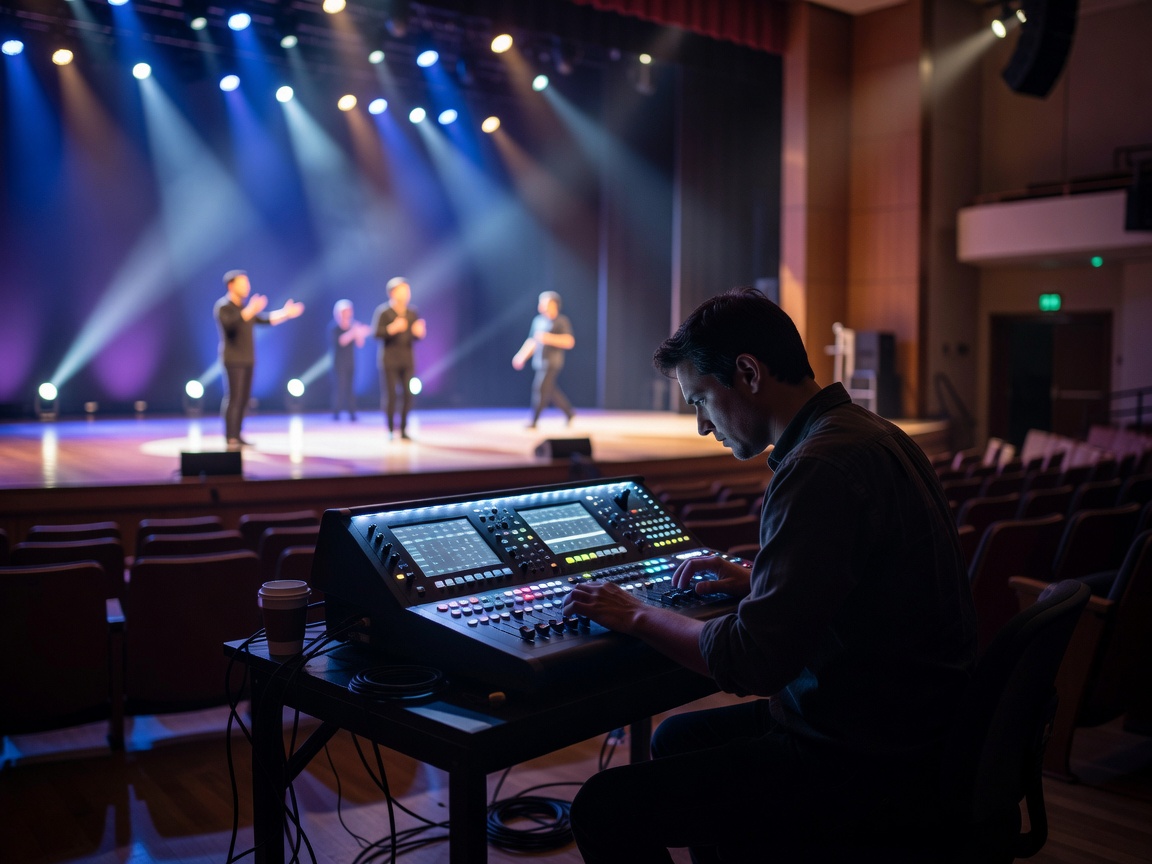
Agree on colour temperature and camera behaviour
Mixed colour temperatures are one of the most common reasons a stream looks "off". If the front light is set to around 5600 K daylight balance but the backdrop practicals are warm 3200 K tungsten, the camera can only white-balance for one of them. Ask your lighting and video teams to agree on a target colour temperature for faces, and to set the camera white balance during the same session.
LED fixtures and LED walls can also flicker on camera. This is usually a relationship between the fixture's refresh or PWM frequency and the camera's shutter speed. It is easy to fix in rehearsal and very hard to fix live, which is why the camera team should look at the lighting states before doors open, not during the first speaker.
Contrast matters too. A bright LED wall behind a presenter will push the camera's exposure down and leave faces dim. The answer is usually more front light, a dimmer screen level, or both. That decision touches three departments, so make it in one conversation.
How control signals reach the fixtures
Modern rigs are controlled from a console such as an ETC Eos family desk or a grandMA3. The console sends data over a network using sACN (ANSI E1.31) or Art-Net, and nodes convert it to DMX512-A (ANSI E1.11), the long-standing standard where each universe carries 512 channels.
- Consolecues and timing
- NetworksACN or Art-Net
- Nodeconverts to DMX
- DMX universe512 channels
- Fixturesaddressed units
Why should an organizer care? Because if the lighting console also receives timecode or triggers from video, a single network fault can affect both. Ask whether the lighting network is isolated or shared, and what happens if it drops.
Structure cues around the running order
A lighting cue is a recorded state with a timing. Good cue lists mirror the running order, so the stage manager can call them without guessing. A typical conference opening might look like this:
- House at full, stage in preset as audience enters.
- House to half, voice-of-god announcement.
- House out, stage wash and screen open for opening video.
- Host walks on: front light to lectern, back light up.
- Panel setup: wider wash covering four chairs.
- Break: house up, stage to walk-in look.
Share your running order early, and tell the lighting designer about every walk-on, award, video playback and audience Q&A. Each is a potential cue.
| Task | Organizer | Lighting designer | Qualified rigger / electrician |
|---|---|---|---|
| Running order and presenter positions | Provides | Uses for plot | — |
| Lighting plot and cue list | Reviews | Designs | Consulted |
| Hanging loads and truss | Confirms venue approval | Specifies | Designs, installs, certifies |
| Temporary power distribution | Books supply | States demand | Installs and tests |
| Camera colour balance check | Schedules time | Adjusts states | — |
Questions to ask your lighting designer
- Which positions light the presenters' faces, and are they approved by the venue?
- What colour temperature will faces be set to, and when will cameras check it?
- How many cues are planned, and who calls them?
- What is the backup if the console or network fails?